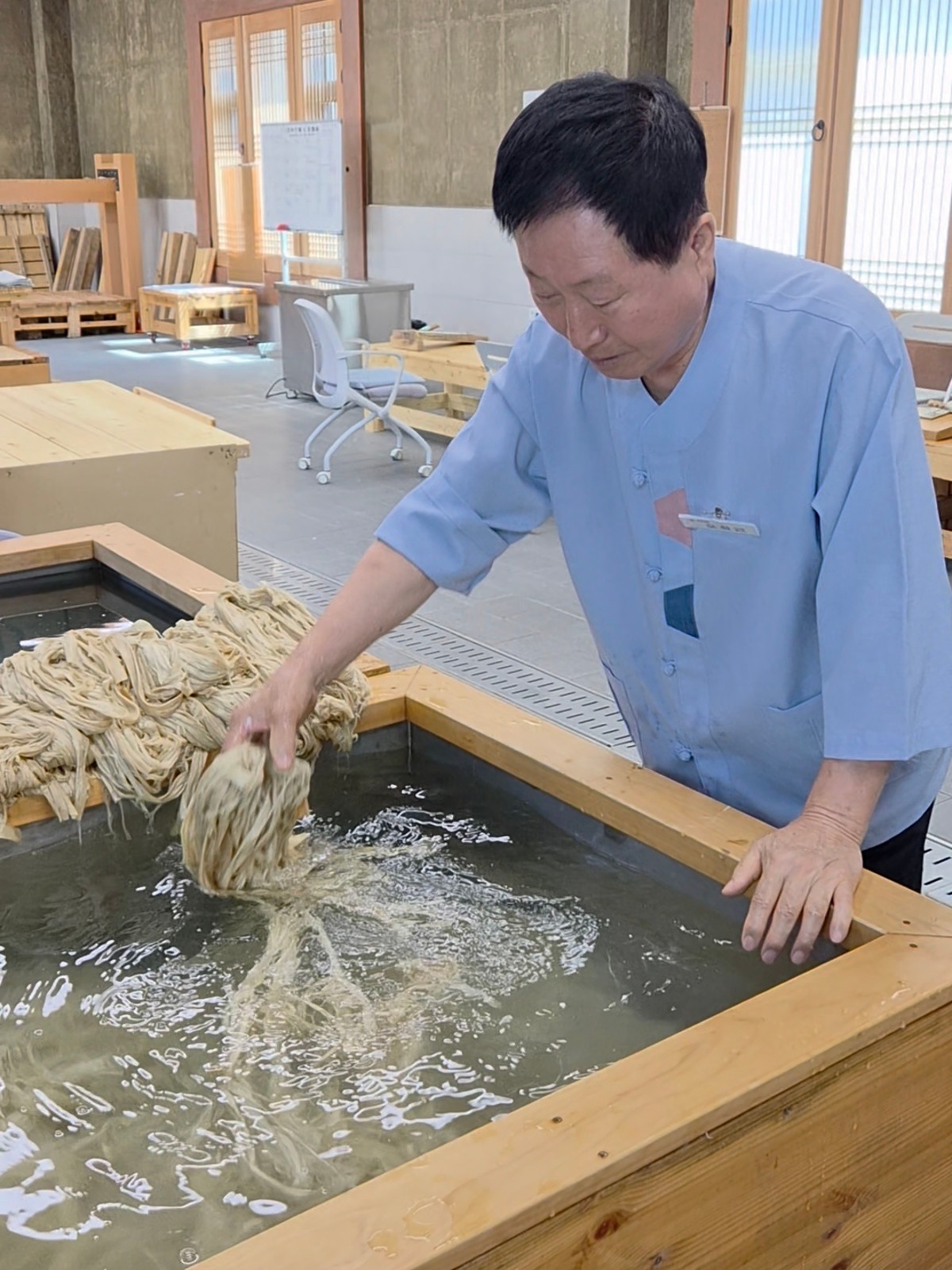
I work with hanji every day, but I wanted to see for myself how this paper comes to life. So I visited the Jeonju Millennium Hanji Center.
Heugseok-gol in Jeonju was once a village full of hanji workshops. Today, hanji is still made here by traditional methods.
It all begins with the paper mulberry tree. The bark is stripped, and its inner layer is boiled in lye, rinsed in clear water, and beaten to loosen the fibers. The fibers are then mixed in water and lifted out one sheet at a time, pressed to remove the water, and dried on a warm ondol floor. Only then does it become a sheet of hanji. People say it takes a hundred touches to make one sheet, which is why it is also called “baekji.” I only understood that after watching it done.
There I met Kim Jin-myeong, a young man in his thirties.
He heard that traditional hanji workshops across the country had been disappearing, and that even in Jeonju, there was no one left to carry on the craft. Saddened to see the tradition fading away, he told me he decided to learn hanji-making himself.
He has been studying at the Traditional Hanji Master Craftsman Academy since June 2025. It takes the full 30 months, he explained, before one can truly be said to have mastered hanji-making.
Every day, he comes to the Jeonju Millennium Hanji Center. In the morning he learns the craft of sheet-forming (chojji) from the master hanji artisans, and the afternoons are filled with research and endless practice. In October, he also took part in a workshop with master artisans from China and Japan, comparing the papers of each country.
We both work with the same paper, so we had a lot to talk about, and we became friends. It was a lovely time, with someone who makes hanji and someone who creates with it, talking about the same sheet of paper.
Every sheet of hanji I touch at Bukchon Hanji Studio carries this kind of work.
When you meet hanji in class, I hope you will remember this story too.